
About Us
Our History
Nearly three centuries of faith in Edgecombe County, from a small wooden church near Chapel Springs to the Calvary we know today.

“O Lord, I love the house in which you dwell, and the place where your glory abides.” Psalm 26:8 NRSV
Beginnings
- 1742 Plans begin for a small wooden church near present-day Chapel Springs, about eight miles northwest of Tarboro.
- 1747 St. Mary’s Church is completed. The Rev. James Moir serves as rector, reporting to the Bishop of London.
- c. 1760 St. Mary’s burns, and the congregation moves to the newly established town of Tarborough.
- After the Revolution The town takes over the congregation’s primary worship building. The parish, then known as Trinity, dwindles.
- 1833 Under the Rev. William Norwood the parish is renamed, and on May 29, 1833, Calvary is admitted into union with the Diocese of North Carolina, the date we celebrate as our founding.
Building Calvary
- 1840 The first church, a wooden building, is completed and consecrated. It is deconsecrated in 1929 and later razed.
- 1858–1868 The present Gothic Revival church, designed by William Percival and built by Thomas Coats, is begun in 1858, completed in 1867, and consecrated in 1868 at a cost of about $25,000. The third rector, the Rev. Dr. Joseph Blount Cheshire, insisted it seat 500 people, though the parish then had only 33 communicants.
- c. 1900 The nave’s oil lamps are electrified. The lamps and pews are original, and the altar, Bishop’s Chair, Deacon’s Chair, and acolyte stalls are believed to be made from oak left over from building the Confederate ram Albemarle.
- 1923 The Joseph Blount Cheshire Memorial Parish House and All Saints’ Chapel are completed under the Rev. Bertram E. Brown, ninth rector.
- 1926 The Cloister and the walls and gates of the churchyard are finished.
- c. 1938 The present Rectory on Saint Patrick Street is built.
- 1960 Memorial Hall is completed under the Rev. John Shelby Spong, fourteenth rector.
- 2014 Calvary acquires the Matthewson House (c. 1869) and adjoining acreage.
Serving the community
- 1870 St. Luke’s Mission is formed from Calvary’s African-American membership. The Vestry authorizes land on Panola Street in 1890, and the present St. Luke’s Church is built in 1892.
- Early 1900s Calvary organizes and administers about a dozen Episcopal missions across Edgecombe County.
- Tarboro Community Outreach Calvary’s early soup kitchen and pantry help found this organization, which today runs a shelter, hot meals, and a food pantry.
Gatherings, recognition, and restoration
- Diocesan conventions Calvary hosts the convention of the Diocese in 1790, 1793, 1794, 1938, and 1960.
- Mid-1980s The Parish House is renovated under the Rev. Douglas E. Remer, seventeenth rector.
- 1987 Calvary hosts the celebration of 200 years of Episcopalians in North Carolina, attended by Presiding Bishop Edmund Browning.
- 1994–1995 The steeple and cross are rebuilt after a severe storm.
- 1999 The Parish House, All Saints’ Chapel, and Memorial Hall are restored after flooding from Hurricane Floyd.
- 2008–2009 Brickwork is re-pointed, lighting and wainscoting are renewed, and the pews and loft are restored under the Rev. William E. Smyth, eighteenth rector.
- Today The church and grounds are listed on the National Register of Historic Places, and the church is a designated Historic Living Church. Since 1833, Calvary has been served by 19 rectors and has produced four bishops.


Thomas Price Miller
Parish Historian
Oral History
Vestry Minutes
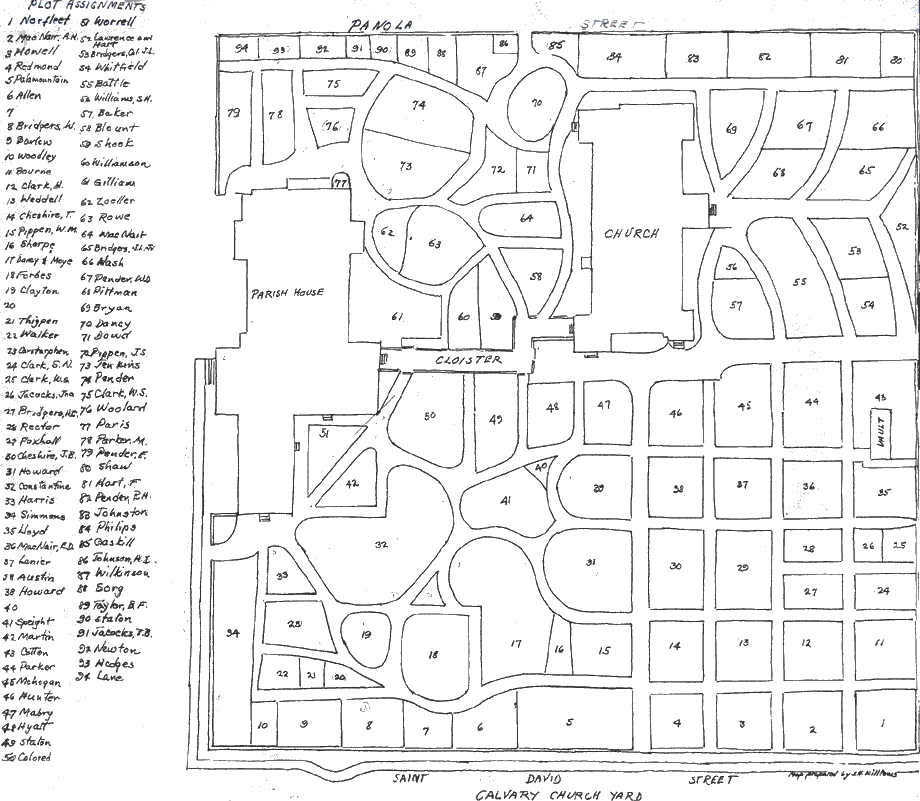
Burials
Explore further
Our parish archives hold oral histories, vestry minutes from 1898, burial records, and photographs from Calvary’s past.